
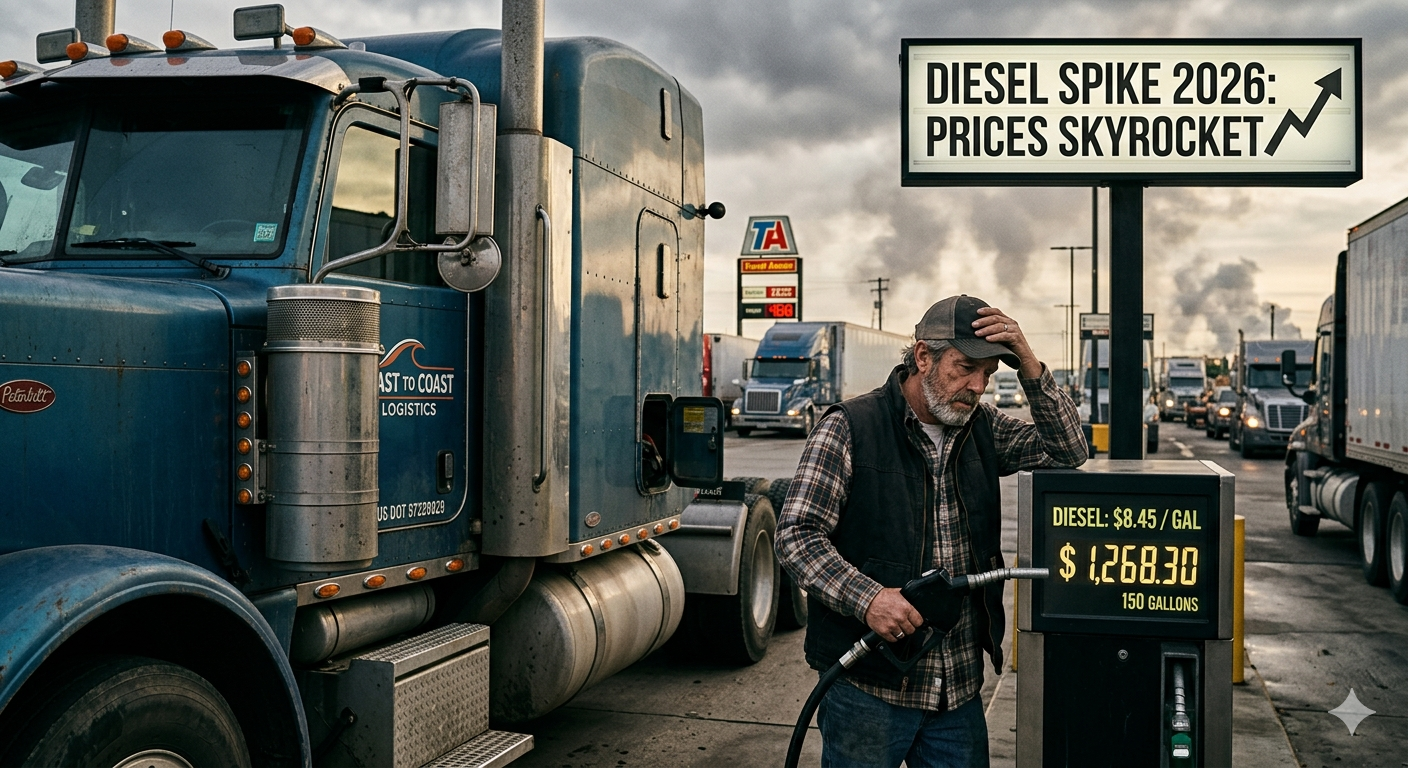
If you have been watching your fuel receipts lately, you already know the numbers are ugly. But the full picture is even worse than what you see at the pump.
The national average for on-highway diesel hit $5.40 per gallon for the week ending March 30, 2026, according to the U.S. Energy Information Administration. That is more than 50% higher than the same period last year and closing in on the all-time record of $5.81 set during the Russia-Ukraine conflict in June 2022. In California, diesel has surged past $7.00 per gallon. Some analysts warn prices could exceed that 2022 record within weeks if global supply disruptions continue.
For the trucking industry, the backbone of the American economy, this is not just a budget problem. It is an existential pressure test.
The root cause is geopolitical. Conflict involving Iran has severely disrupted the Strait of Hormuz, the narrow waterway through which roughly 20% of the world’s daily oil supply normally flows. Even though the U.S. has adequate domestic diesel supply, oil trades on a global market. American carriers absorb the price increases just the same.
The cascade was swift and severe. From March 2 to March 16, 2026, the average nationwide price of diesel rose from $3.89 to $5.37 per gallon. In just three weeks, fuel costs per mile increased by 21 to 24 cents, the largest such increase on record according to FTR Transportation Intelligence.
Earlier in the year, analysts had expected diesel to average around $3.50 per gallon through 2026, with crude expected to fall. Instead, the geopolitical shock flipped that forecast on its head in a matter of days.
"The outlook for diesel fuel, up until the Iran conflict, was that it was going to continue to drop. Some experts showed it dropping significantly throughout 2026." - Steve Patton, CEO, Patton Logistics
Trucking runs on thin margins in the best of times. Long-haul companies typically operate on net profit margins of 2 to 4%, with fuel representing 25 to 35% of total operating costs. At current price levels, fuel has gone from a manageable line item to a potential company-killer.
A $1 per gallon increase in diesel raises annual fuel costs by more than $9,000 per truck. For a fleet of 50 trucks, that is $450,000 in additional annual expense before anything else changes. For a fleet of 200 trucks, the math approaches $2 million. Small and independent carriers have no hedge, no buffer, and no relief valve.
Patton Logistics, based in Milton, Pennsylvania, buys roughly 100,000 gallons of fuel per week. The CEO reported that his company averages 4.5 million uncompensated miles annually for deadhead runs, consuming 700,000 gallons of diesel in those miles alone. At a $2-per-gallon increase, that is $1.4 million per year in pure uncompensated fuel cost.
Carriers are passing costs through to shippers via fuel surcharges. But in a competitive freight market, surcharge increases lag price spikes by weeks. In the interim, carriers absorb the difference. For smaller owner-operators, that gap between what diesel costs and what the surcharge covers can mean the difference between a profitable load and a losing one.
Research from C.H. Robinson confirms: sustained oil-market volatility is putting upward pressure on fuel surcharges and all-in freight transportation rates, with higher diesel prices intensifying stress on carrier margins and potentially accelerating capacity exits.
Regional pricing disparities are widening. While the Midwest and Gulf Coast saw some price relief in late March 2026, California’s diesel costs continued climbing past $7.00 per gallon, nearly $2.00 above the national average. West Coast carriers who fuel primarily in their region and receive surcharges based on the national average are effectively subsidizing their own fuel costs.
A 10% increase in fuel costs can raise freight expenses by 2 to 4%, putting immediate margin pressure on every load.
Trucks move more than 70% of all freight across the United States. When trucking costs spike, the impact reaches every corner of the economy within weeks.
The University of Virginia’s Darden School of Business documented the mechanism clearly: diesel powers not just trucks but farm equipment, construction machinery, fishing vessels, and the full domestic freight network. When diesel prices jump, the cost of moving everything from produce to pharmaceuticals goes with them.
When transportation companies face a $1 per gallon increase, 60 to 80% of that cost increase gets passed through to shippers within 30 to 60 days. When multiple transportation segments each add their margin on top of a fuel surcharge, the compounding effect reaches consumers at the grocery store, the hardware store, and everywhere in between.
The national average diesel price in Canada has increased nearly every week in 2026. For a North American supply chain that depends on seamless cross-border trucking, the pressure is continental, not just domestic.
The same conflict that disrupted oil flow through the Strait of Hormuz also affected LNG production, aluminum supply chains, and the chemicals used to make fertilizer, plastics, and packaging. Factory slowdowns in Asia, driven by energy rationing, are beginning to constrain the flow of electronics, apparel, appliances, and auto parts into North American distribution networks.
The supply chain disruption is not just about fuel. It is about everything that depends on fuel to exist.
As smaller carriers face unsustainable fuel economics and exit the market, capacity shrinks. Spot rates for dry van are forecast to climb toward $2.75 to $2.90 per mile later in 2026. But rising rates are not keeping pace with fuel cost inflation. For many carriers, rate increases are a pressure release valve that is not releasing fast enough.
You cannot control the price at the pump. You can control how much fuel you burn and how strategically you manage every gallon. Here is where to focus your energy.
If any of your contracts lack a fuel surcharge clause tied to the weekly DOE national diesel index, renegotiate them immediately. Surcharges based on a $1.20 per gallon baseline and 6.5 MPG assumptions can significantly underpay you at current price levels. Review every rate confirmation against current FSC tables. If your broker’s surcharge is more than $0.04 per mile below benchmark, the table assumptions are working against you. Get this language right before fuel prices move again.
This is not optional right now. A well-maintained engine versus a neglected one can mean a 10 to 20% difference in fuel consumption. That is $0.50 to $1.00 per gallon in effective savings without any change in fuel price. Priorities: regular oil and filter changes using low-viscosity oil, air filter cleaning and replacement, tire pressure checks at every fuel stop (under-inflated tires add 0.3% fuel cost per PSI), and valve calibration. Fleet operators running 50 trucks can reduce annual fuel expenses by hundreds of thousands of dollars through disciplined maintenance alone.
Uncompensated miles are now catastrophically expensive. Patton Logistics is paying $1.4 million more per year in uncompensated fuel costs alone. Route planning software, load boards, and freight matching platforms should be deployed aggressively to reduce empty miles. Use Trucker Path, DAT, or similar tools to find backhauls before you commit to a one-way run. Every empty mile at $5.40 per gallon diesel is money you cannot recover.
Regional price variation is significant. GasBuddy, Mudflap, and Trucker Path all provide real-time diesel pricing. With a $0.50 or more per gallon spread between truck stops in some regions, strategic fueling decisions across a full tank of 100 to 150 gallons can save $50 to $75 per fill-up. For a driver making 5 fills per week, that is $250 to $375 per week in pure savings. These apps also integrate with fleet discount programs that can compound the savings further.
Fleet fuel cards (Comdata, WEX, EFS) and trucking fuel networks offer per-gallon discounts at partner truck stops. At current prices, even a $0.10 to $0.15 per gallon discount represents meaningful savings at scale. If you are not enrolled in a fleet discount program, enroll now. If you are enrolled, audit whether your drivers are fueling at partner locations consistently. Compliance gaps in fuel programs often represent more leakage than the program saves.
Aerodynamic drag increases exponentially with speed. Driving at 65 mph versus 75 mph improves fuel economy by roughly 10 to 15%. At $5.40 per gallon, that difference is worth enforcing. Similarly, one hour of idling burns approximately one gallon of diesel. A truck idling two hours per day at current prices burns $10.80 in fuel with the engine parked. Fleet operators should set idle-time limits, use APUs (Auxiliary Power Units) for cab comfort instead of engine idling, and monitor compliance through ELD data. These behavioral changes cost nothing to implement and the savings are immediate.
The 2026 diesel spike is not a temporary inconvenience. It is a structural shock driven by a geopolitical disruption that has no clean resolution timeline. The carriers that survive and grow through this period will be the ones that treat fuel management as a core operational competency, not an afterthought.
For fleet owners, the question is not whether fuel costs are too high. They are. The question is how much of that cost you can recover through smarter operations, sharper contracts, and disciplined driving practices.
Every gallon of diesel you save right now is worth more than it has ever been.
About DocuDrive Solutions
DocuDrive Solutions helps trucking companies and fleet operators streamline their documentation, compliance, and operational workflows so they can focus on what matters most: running efficient, profitable routes. Learn more at www.docudriveapp.com.
