
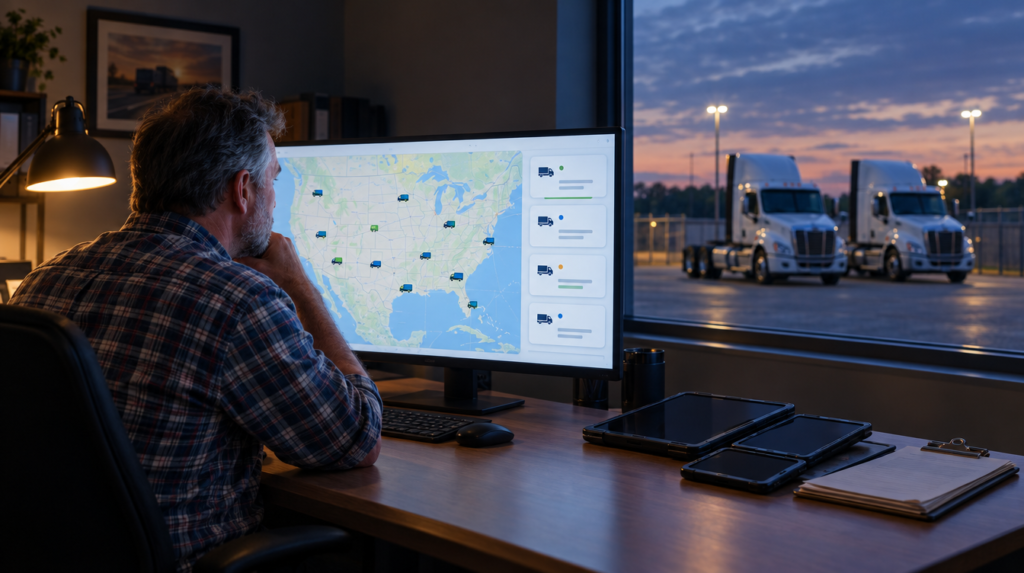
Somewhere in your inbox right now there is a pitch for AI dispatch. Maybe it promises to plan your loads, catch a maintenance problem before the truck does, or handle the paperwork while you sleep. The big telematics platforms spent the summer announcing exactly that, and the sales calls follow the press releases.
Here is what nobody puts in the press release. Two surveys this year asked fleets what is actually stopping AI from paying off, and the answer was not the price tag. It was the data. The fix is cheaper than the pitch, and it helps you whether or not you ever buy the AI.
The hype cooled, and the numbers say why
Fleet Advantage runs a yearly survey on how private fleets use AI, and the 2026 edition, released in May, reads like a reality check. Last year the top barrier to AI was cost. This year it is data integration, named by 71 percent of fleets, with inaccurate data close behind at 64.5 percent.
The number that should stop a fleet owner cold is this one: 51.6 percent of fleets collect ELD and telematics data and do not connect it to any AI tool at all. Only 9.7 percent feed that data into a model for real time insight. So the trucks are generating the raw material every mile, and for half the industry it goes into a portal and sits there.
Interest followed the friction. A year ago 57.1 percent of fleets said they were interested in so called agentic AI for procurement. This year that figure is 9.7 percent. Fleets tried it, found out what it takes, and backed off. That is a signal about what has to come first.
Where the data actually breaks
If you run 5 to 50 trucks, you already know the shape of the problem even if you have never called it data integration. The ELD is from one vendor. The GPS came bundled with the insurance discount from another. The dashcams were a third purchase after a claim went sideways. Inspections are on paper or in a fourth app. Each system is fine on its own. None of them talk.
That is what inaccurate data looks like in practice. The ELD says the truck was on duty in Tulsa. The GPS pings put it forty miles north, because the GPS unit is on a different clock or a different asset ID. The camera clip is timestamped in a different time zone. A dispatcher trying to answer a simple question, like whether a driver has hours to take a backhaul, opens three tabs and does the math by hand. An AI tool asked the same question gets three answers and picks one.
A panel of fleet technology leaders at ACT Expo this spring put it plainly: AI accelerates whatever you feed it, including your mistakes.
The one platform test
Here is a quick test of whether your fleet is ready for any kind of automation. Pick one truck. Without leaving a single screen, can you see where it is right now, what the driver’s remaining hours are, whether this morning’s pre-trip was completed and what it flagged, and pull the last dashcam event with a timestamp that matches the GPS trail?
If the answer is yes, you have an AI ready fleet whether you meant to build one or not. Every question an AI dispatch tool would ask already has one answer.
If the answer involves three portals and a text to the driver, no AI product is going to fix that for you. It will sit on top of the mess and guess faster.
Three things to fix before anyone says AI
First, consolidate the trucks onto one platform. ELD, GPS, cameras, and asset tracking reporting into one dashboard, one login, one set of timestamps. This is the entire data integration problem for a small fleet, and it does not require an IT department. It requires picking a platform that does all four and moving the trucks over. Do it truck by truck if you have to.
Second, clean up the identifiers. Every truck should have one name that is the same in the ELD, the GPS, the camera, and your maintenance records. Not unit 12 in one place and the last six of the VIN in another. This sounds trivial and it is the single most common reason fleet data cannot be joined together later.
Third, make inspections digital and attached to the truck. A DVIR that lives in the same system as the ELD and the GPS becomes a maintenance record, a defense in an inspection, and, eventually, the history an AI maintenance tool would need. A DVIR in a glovebox binder is none of those things.
None of these steps are AI. All of them are the reason AI works for the fleets it works for, and they pay back immediately in fewer phone calls and cleaner audits.
What AI ready looks like for a twelve truck fleet
Picture a twelve truck regional carrier that moved everything onto one platform in the spring. Plug in ELD, GPS on every power unit and trailer, a dual facing camera on the highway trucks, DVIR in the app. By fall the owner can answer the one truck test in under a minute.
Now the AI dispatch pitch lands. The owner can judge it on the merits instead of the demo, because the data the tool needs already exists in one clean feed. If it is worth it, integration is a conversation, not a project. If it is not, the fleet lost nothing, because the platform was already paying for itself. The fleets that are ready for the next wave will not be the ones that bought the most software. They will be the ones whose trucks all reported to the same place.
The takeaway
The technology story of 2026 is not that AI came to trucking. It is that half the industry found out their data was not ready for it. For a small fleet that is good news, because the fix is the same practical consolidation that saves money on day one: one platform, one set of names, digital inspections attached to the truck.
DocuDrive puts GPS tracking, fleet cameras, ELD compliance, and asset tracking on one platform, with published pricing from $8 a month, free setup, and no contract. The free Fleet Technology Assessment at docudriveapp.com takes about ten minutes and shows you exactly where your data is split. When the AI pitch shows up, you will be the one asking the hard questions.
Leave a Reply