
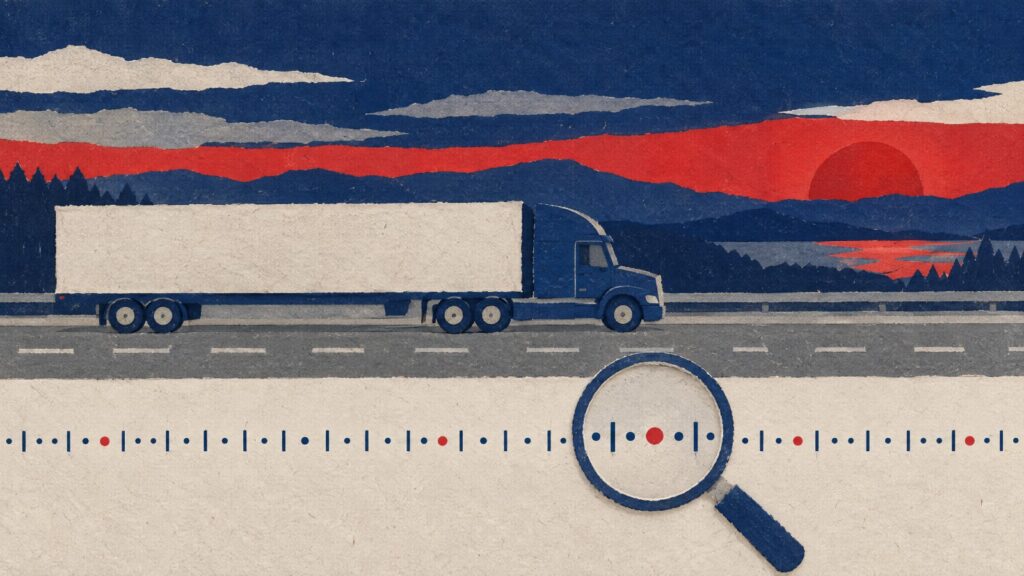
After a serious crash, the first call goes to the driver. The second often comes from a lawyer who wants your data.
Two attorneys at Lightfoot, Franklin & White, Anne Hughes and Lee Hollis, put it plainly in a Nov. 2 CCJ article: after a serious truck crash, a plaintiff’s attorney will “almost certainly” ask for the carrier’s telematics data. The request often reaches well past the minutes before impact. It can include safety scores, months of alerts, and notes on what supervisors did about them.
If you run 5 to 50 trucks, that is worth ten minutes of your attention before the bad day, not after it.
The data does not stay in the cab
Hughes and Hollis write that telematics data is generally discoverable, which means the other side can ask to see it. Courts differ on how much. Some limit requests to the truck, the driver, and a window around the crash. Others order everything requested, especially when the lawsuit also claims negligent hiring, training, or supervision. The authors cite a 2023 federal case in Alabama where the court ordered six months of one driver’s telematics data and noted that earlier data could be ordered too.
They also point out that courts generally treat data sitting with your provider as yours to produce, as long as you can reach it through a dashboard. “My vendor has it” is not much of a defense.
Picture a 15-truck fleet that installed cameras and a scoring system two years ago. Nobody was ever assigned to read the alerts, and the system quietly stores everything. After a crash, that whole history is fair game for a request, and the real question becomes what the company knew and what it did about it. That is the question Hughes and Hollis say plaintiffs are trying to answer.
It can clear you, too
None of this is a reason to rip out cameras or stop tracking trucks. The same records that get requested also win cases. The authors describe a 2024 New York case where speed data showed the tractor-trailer could not have caused the accident as alleged, and the court granted summary judgment for the carrier. Steady speed, a safe following distance, and appropriate braking are all things the data can show when an eyewitness gets it wrong.
Drivers know this. In Geotab research from December 2025, covering more than 500 commercial drivers, 58 percent called dash cams critical for exoneration in a collision, and 63 percent valued them for protection against fraudulent insurance claims. The people behind the wheel are not the ones afraid of this tool.
Collecting data and ignoring it is the real risk
Here is the part that catches small fleets. Hughes and Hollis warn that a written policy promising monitoring that the company does not follow can become a strong exhibit for the plaintiff. A gap between what you say you watch and what you do about it can feed negligent supervision claims. The safeguard they describe is a closed loop: detect, review, and take documented action.
For a small fleet, that does not need to be fancy. Pick one person who owns the alerts. Have them look on the same day each week. Write down what happened next, whether that was a phone call, a coaching note, or a retraining. Ten minutes a week builds a record that shows you paid attention.
Four things to settle before something happens
Retention. Find out what your system captures, how long it keeps it, and how auto-deletion works. Whatever you choose, write it down and follow it every time.
Your vendor contract. Ask how long your provider keeps data, how you can export it, and what happens to it if you leave. Changing providers does not necessarily end the inquiry, the authors add, so ask about old data before you switch.
A hold plan. Decide ahead of time, with your attorney, who orders data preserved after a serious accident and how that notice reaches your provider. The authors describe a Georgia case where a carrier’s failure to preserve GPS data supported a spoliation motion, which is a request for penalties over lost evidence.
An alert owner. One name, one routine, one place to log what was done.
This is general information, not legal advice. Your attorney and your insurance agent can tell you what applies to your operation.
The takeaway
Fleet data is going to be read by someone after a bad day. Decide now what it will say: that you watched, that you acted, and that you kept the records.
If you want a second set of eyes on what your trucks are collecting, who looks at it, and how long it stays around, DocuDrive offers a free Fleet Technology Assessment. GPS tracking, fleet cameras, ELD compliance, and asset and temperature tracking live on one platform, with published pricing from $10 a month, free setup, and no contract. You can see how it fits on our solutions page.
Leave a Reply